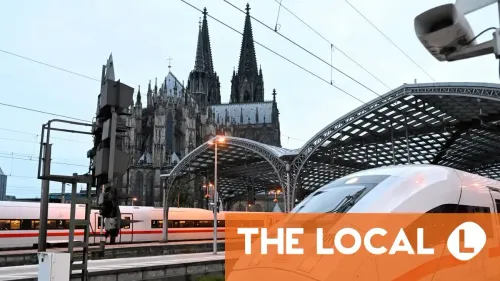

German train stations rank as Europe's least reliable as delays reach record levels
Passengers at German railway stations experience significantly longer delays than travelers in other major European cities, according to a new survey that places Berlin Central Station among the worst performers with average waiting times of 20 minutes.
The latest European Railway Index shows German cities filling all 10 bottom positions in reliability rankings, with nearly one in every two trains experiencing delays. This marks a continuation of a troubling trend: Deutsche Bahn's long-distance train punctuality has plummeted to 60.1% in 2025, down from 62.5% in 2024 and 74.4% in 2015, representing the worst performance on record.
While European passengers typically wait an average of eight minutes at the continent's busiest stations, German travelers endure delays averaging nearly 15 minutes. The situation is particularly acute in long-distance services, as regional trains maintain a far better 89.1% punctuality rate, demonstrating that delays predominantly affect IC and ICE trains rather than regional services.
Dortmund leads delay rankings
Dortmund recorded the highest frequency of disruptions, with 73.8% of trains facing delays. Neighboring Cologne followed closely with 71.5% of trains delayed, while Hamburg, Bremen and Essen rounded out the worst performers.
At Berlin Central Station and Frankfurt am Main, two of Europe's busiest hubs, approximately 61% and 57% of trains were delayed respectively. Hamburg passengers experienced the longest average delays of nearly 25 minutes.
These figures align with Deutsche Bahn's own data, which shows just 54.2% of long-distance trains arrived on time in August. However, the true passenger experience may be worse than official statistics suggest, as Deutsche Bahn defines a train as on time if it arrives less than six minutes after schedule.
Infrastructure modernization struggles
Deutsche Bahn has consistently attributed low reliability to aging infrastructure and is currently modernizing the busiest rail corridors with an investment of over €23 billion in 2026, up from approximately €19 billion in 2025. The operator is managing around 28,000 construction sites across Germany.
Yet on Thursday, DB chief Evelyn Palla admitted that even these construction projects are running behind schedule. In northern Germany, the Hamburg-Berlin route reopened six weeks late this year, while delays in approving new signaling boxes have caused further passenger disruptions.
The Regensburg-Nüremberg route finished three weeks behind schedule, and the Cologne-Hagen route, despite reopening on time, has since experienced lengthy delays after the discovery of a crumbling bridge.
The troubled Stuttgart 21 project exemplifies the scale of the challenge. Originally estimated at approximately €2.5 billion, costs have ballooned to €14.5 billion, representing a cost overrun of nearly 500%. The project is now scheduled for completion in 2031 at the earliest.
In response to mounting difficulties, Palla announced last week that construction works would be slowed further, with just two major projects per year instead of the current four. This adjustment could extend the overall modernization program well beyond the current 2036 deadline.
Competition intensifies
Barely a year into her role, Palla faces mounting pressure to improve service as new competitors prepare to enter the market. Italian operator Italo plans to invest €3.6 billion to enter the German rail market in 2028, connecting 18 cities with 50 daily services on key routes including Munich-Cologne-Dortmund and Munich-Berlin-Hamburg, using 26 Siemens Velaro trains.
Meanwhile, Flixtrain is expanding its German operations with 65 newly ordered high-speed trains capable of speeds up to 230 km/h, expected to enter service from 2028. The company also plans to double its existing fleet capacity within the next two years using refurbished trains.
The German long-distance rail market currently serves 110-120 million passengers per year and could grow by 40-50% with increased competition, according to market analysis.
In a recent interview with Tagesspiegel, Palla expressed optimism about the incoming competition from Italo.
Competition makes the railways faster, leaner and better.