
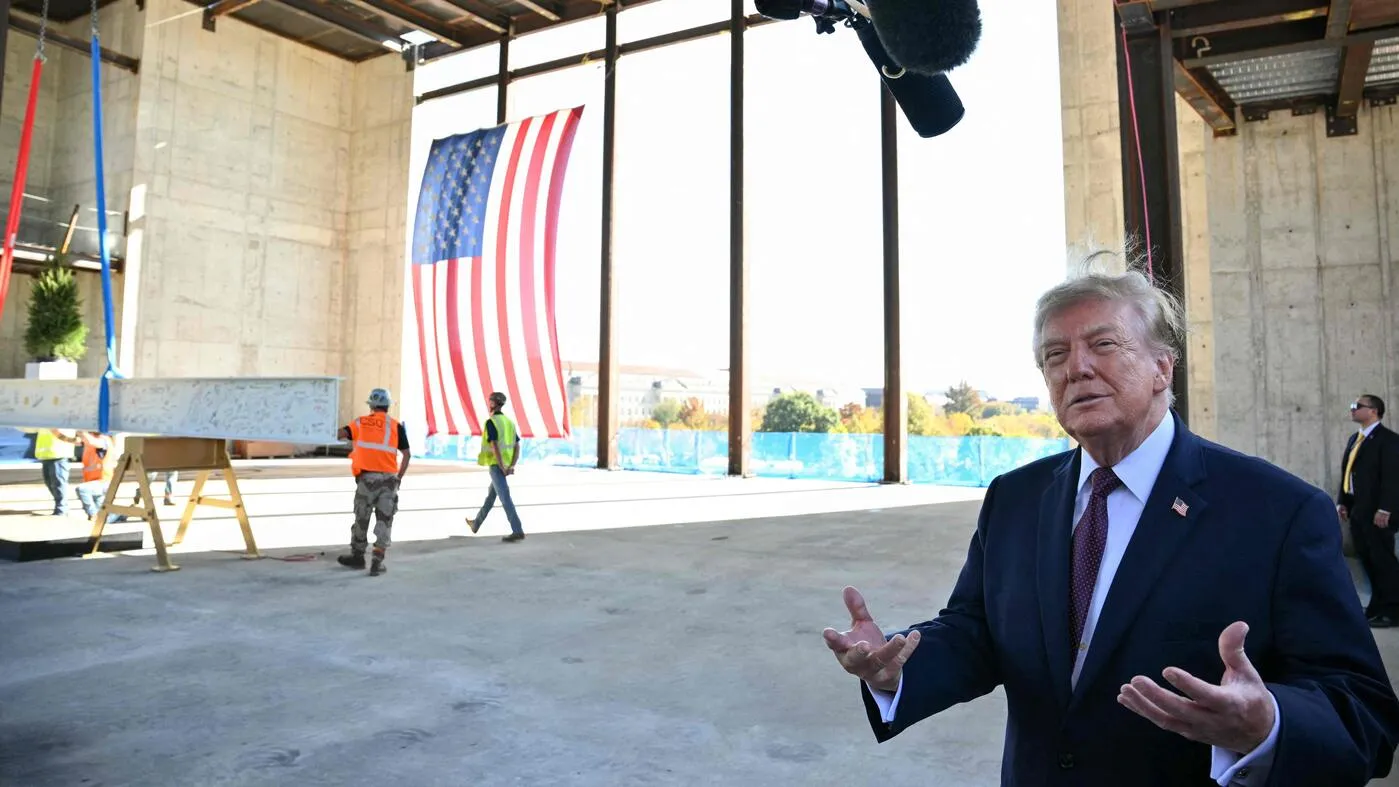
A construction milestone after the election
During Wednesday's visit, Trump praised the marble flooring and planned kitchens, AFP reported. The 80-year-old president used his customary thick black felt-tip pen to add his signature and the word "Love" to a beam already bearing numerous construction workers' signatures. ELLE Decor reported that it was the building's last structural beam, marking the point known in construction as topping out.
Interior Secretary Doug Burgum called the occasion a day for celebration and praised Trump's skills as a builder. Trump said the ballroom would be the most beautiful in the world and larger than Beijing's Great Hall of the People, where Chinese President Xi Jinping had welcomed him with military honors in May.
The ballroom, bunker and opening schedule
The ballroom occupies about 22,000 square feet within a new East Wing building of roughly 90,000 square feet. It will seat approximately 1,000 guests. According to ELLE Decor, Trump has repeatedly said its ceilings will reach up to 40 feet.
The building has reached its final height of 51 feet and will have two above-ground floors, along with a new underground national security center. Wikipedia's White House State Ballroom entry describes a six-story bunker beneath the new East Wing, replacing the Presidential Emergency Operations Center demolished with the original wing. Trump said in May 2026 that the bunker would include a military hospital, research facilities and meeting rooms.
USA TODAY reports that construction is slated to finish in summer 2028. On May 15, 2026, Trump announced a scheduled opening in September 2028; the White House says the project will be complete before his term ends in January 2029.
Legal challenges and disputed financing
Trump ordered the historic East Wing demolished in October 2025 to make space for the ballroom. Preservationists accuse his administration of bypassing legally required reviews and proceeding with the demolition without congressional approval.
The National Capital Planning Commission approved the project design on April 2, 2026, according to Wikipedia. On June 4, a Senate amendment seeking to halt construction until Congress authorized it fell short of the required 60 votes. Six Republicans joined Democrats in supporting the measure, which failed on a 52-47 vote.
After months of litigation, the U.S. Supreme Court allowed construction to proceed until further notice on August 31, 2026. USA TODAY and Wikipedia report that the 5-4 ruling rested on legal standing: the majority found that the National Trust for Historic Preservation and architectural historian Alison Hoagland lacked standing to sue. The justices did not decide the merits of the challenge.
Financing remains contested. Trump says the project is entirely privately funded, while U.S. media have reported that taxpayers could cover a substantial share of costs estimated at up to $600 million.
According to Wikipedia, the estimate climbed from $200 million when the project was announced in July 2025 to $300 million that October and $400 million by December. A March 5, 2026, internal estimate from contractor Clark Construction put the cost at $600 million and projected that taxpayers would pay more than half.
Other Washington building projects
At the ballroom site, Trump also promoted other projects he says will beautify Washington, including a large triumphal arch near Arlington National Cemetery that faces a legal challenge. Figures cited by Sen. Elizabeth Warren and reported by USA TODAY put his Washington construction projects at more than $1 billion, with White House and Lafayette Park renovations accounting for over $927 million.
Former President Barack Obama mocked Trump's focus on renovations during the election campaign. He joked that Trump was preoccupied with home improvements, describing gold medals superglued to the Oval Office fireplace, the paving of the Rose Garden and a ballroom larger than the White House.