
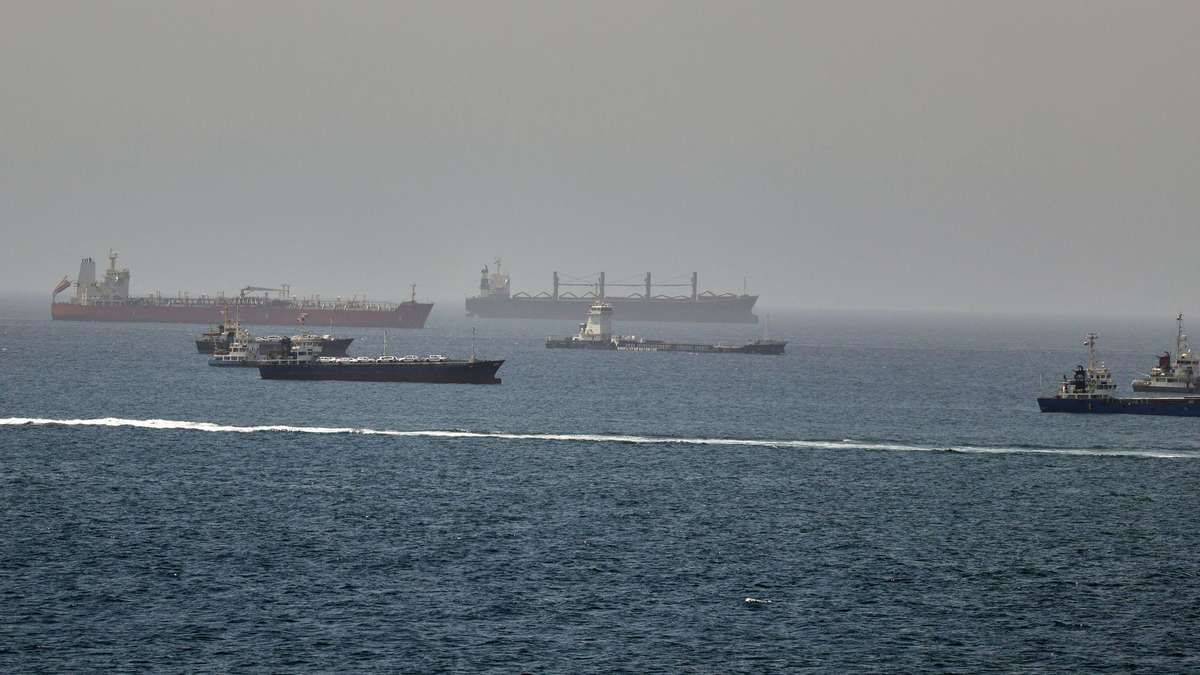
Cargo ship struck near UAE coast
US Central Command, or CENTCOM, said an American military aircraft used precision munitions to strike the stern of the M/V Huda, leaving the vessel unable to maneuver. The Turkish-operated bulk carrier flies the flag of St. Kitts and Nevis and can carry almost 25,000 metric tons.
According to the US account, the crew ignored warnings and attempted to breach the naval blockade of Iranian ports. US forces instructed the civilian crew to leave the areas they intended to target before opening fire.
The strike occurred about 18 nautical miles east of Khor Fakkan on the United Arab Emirates coast. The British maritime monitoring agency UKMTO confirmed military involvement in an incident overnight into Sunday, November 8, but initially provided no information about casualties or environmental damage.
For months, the US military has also conducted covert escort operations to protect merchant ships in the Persian Gulf.
Airstrikes on Qeshm, unexplained impact in Jask
Around the same time, US warplanes struck Iranian air defense positions and missile launchers near Suza on Qeshm, an Iranian island in the Strait of Hormuz. Heavy explosions shook the island.
President Donald Trump called the attacks "minor strikes". Washington had previously refrained from massive, large-scale attacks on Iran.
Iranian state media reported tremors in Jask, a port city, and other coastal communities. Local officials confirmed an impact, according to those reports, although its cause remained unclear.
Iranian mine claims remain unverified
Iran's Revolutionary Guards told the state news agency IRNA that two tankers caught fire after hitting mines while allegedly following a route that had not been authorized. They did not identify either vessel, and their account could not be independently checked.
Iran has repeatedly reported ship fires in the strait in recent weeks. The US government, by contrast, has maintained that shipping routes have been cleared. CBS News reported that CENTCOM said in early November it had cleared all mines from the waterway and helped Gulf countries export 1.5 billion barrels of oil through Hormuz since the summer.
The wider toll on commercial shipping has been substantial. CNBC, citing International Maritime Organization data, reported that at least 30 vessels had been hit in October as of October 27, 2026. Most were oil tankers, and at least 16 seafarers were injured. The October attack count was double September's 15 confirmed incidents.
Oil shipments face costly detours
The Strait of Hormuz normally carries oil equivalent to about one-fifth of worldwide demand. Iran has largely blocked the passage since the war began in late February, prompting the US to impose its own naval blockade on Iranian ports. CENTCOM said US forces had diverted 147 merchant vessels and disabled five since mid-July.
Shippers have adopted a relay system to keep oil moving. Tankers collect crude at Persian Gulf ports and cross Hormuz with their transponders off, then hand their cargo to other tankers in the Gulf of Oman for delivery to Asian refiners.
Mary Melton, a Braemar analyst cited by CNBC, estimated that this operation was occupying about 20% of the world's supertanker fleet. Daily charter costs for a supertanker traveling from the Gulf of Oman to Asia climbed from $249,000 in early September 2026 to more than $900,000 by the first week of October.
Pipeline alternatives are limited. The International Energy Agency says Saudi Arabia and the UAE are the only countries with operational crude pipelines capable of bypassing Hormuz. Their estimated available capacity is 3.5 million to 5.5 million barrels a day, but the logistics needed to redirect substantial volumes have not been robustly tested.
By early November, global oil prices remained 60% to 70% above their prewar level because of the standoff, CBS News reported, citing the Financial Times.
Katz says Israel's mission is unfinished
Israeli Defense Minister Israel Katz said the mission against Iran was not over, according to dpa. Speaking at a memorial ceremony in Jerusalem, he accused Iran of again seeking nuclear weapons and pursuing other objectives that posed a concrete danger to Israel.
Katz called for unity among Israelis ahead of major tasks still to come. He said Israel was more determined than ever to shape its own fate, preempt possible attacks and act proactively and offensively against its enemies.
Oman pursues talks on control of shipping
Broader negotiations toward a diplomatic settlement have been stalled for months, while the naval blockade remains in force.
Oman said on November 5, 2026, that talks with Iran were continuing over a system under which the two countries would jointly control traffic through Hormuz. According to CBS News, the Omani foreign ministry said such an arrangement could "end the state of war and prevent renewed confrontations in the region."