Questions over contracts
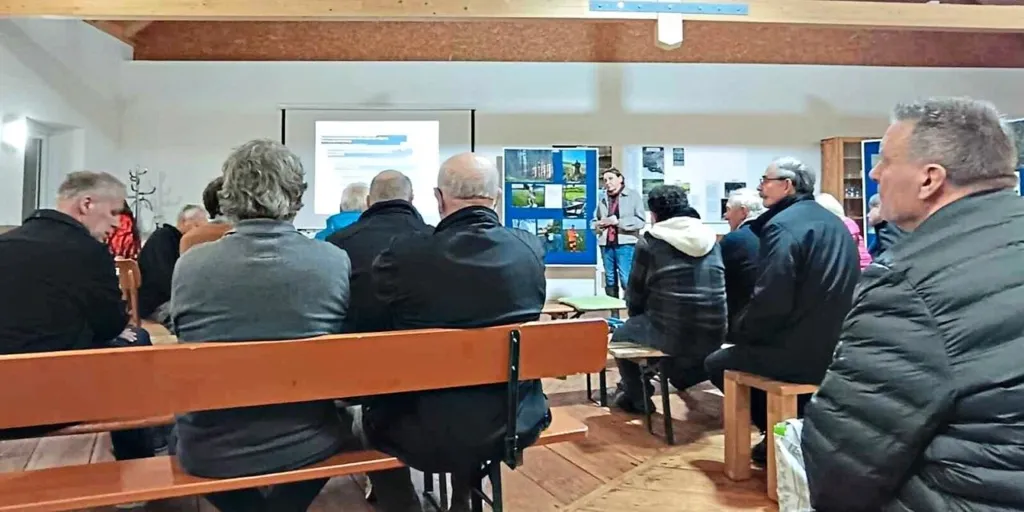
The event focused on the economic viability and profitability of wind turbines in the area and accompanied the picture exhibition "Unser Wald – Unsere Tiere" in Triftern, in the district of Rottal-Inn.
Participants reported that activity in other areas had also quieted after Juwi withdrew from Triftern's preferred wind development area. Speakers Marianne Jetzinger and Dr. Michael Weiß said they found it understandable that Qair had not yet responded to requests and invitations to discuss the contracts.
Qair is a French wind-energy company with plans elsewhere in southeastern Bavaria. In February 2024, erneuerbareenergien.de reported that its proposed project in a forest area in Altötting envisaged 40 turbines rated at 7.2 MW each. With a total capacity of 288 MW and annual generation of around 500 GWh, it would have been Germany's largest onshore wind farm.
The abandoned Lengsham project
Juwi GmbH, based in Rhineland-Palatinate, announced in June 2026 that it was abandoning its planned wind farm near Lengsham in the market town of Triftern and immediately ending all activities at the site. Passauer Neue Presse reported the decision on June 13. Mayor Edith Lirsch welcomed the withdrawal, describing it as a day of great joy.
The project had faced local resistance. In a November 18, 2025, report, the newspaper described the proposed site as lying in the middle of a 70-hectare continuous forest, one of the municipality's last large connected woodland areas.
Regional planning and Bavaria's slow expansion
Wind-area planning was also proceeding at the regional level. In March 2025, the planning committee of the Regional Planning Association Landshut adopted a draft identifying wind priority areas, followed by a public participation process. According to Passauer Neue Presse's March 13 report, Gangkofen and Bad Birnbach continued to have the largest potential wind development areas in Rottal-Inn.
Across Bavaria, wind-power expansion had been very slow, erneuerbareenergien.de reported in February 2024. Authorities approved just 14 new turbines in 2023. The publication attributed that pace to the state's far-reaching de facto minimum-distance requirement, known as the "10-H" rule, which effectively required distances of 1.5 to more than 2 kilometers from settlements.