More capacity on existing sites
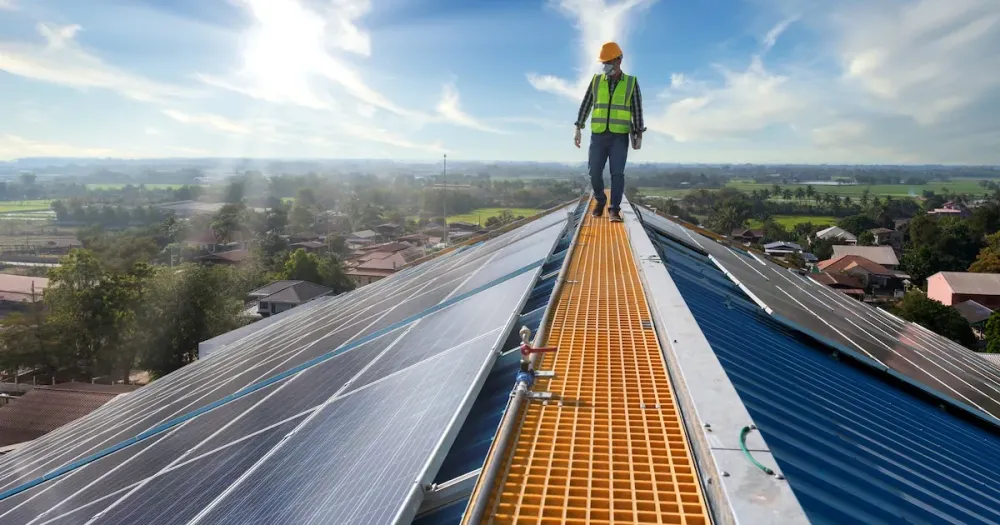
Repowering means replacing older solar modules with newer, more powerful equipment. The sites are already in use, allowing operators to increase output without finding additional land. According to CHIP, replacing modules should be relatively straightforward in most cases, although operators may still need to resolve permitting questions. Upgrading inverters and other components could bring further efficiency gains.
The opportunity reflects both aging equipment and improvements in technology. A Swiss study found that modules operating for more than 30 years still delivered over 80% of their original output. Modern modules, meanwhile, reach efficiencies of 20% to 25%, roughly double those of early systems, and cost a fraction of what operators paid one or three decades ago.
The German Association of the New Energy Economy, known as bne, illustrated the difference with a conservative example in March 2022: replacing modules with 11% efficiency at a 5 MW solar park with modules reaching 22% would increase its capacity to about 10 MW. The park would produce more than twice as much electricity on the same area.
The association also reported that land requirements for ground-mounted solar had fallen from about 2.5 hectares per megawatt in the sector's early years to less than 0.9 hectares per megawatt, with the trend continuing downward.
What the estimates cover
The 25 GW estimate comes from Jan Wannenwetsch's master's thesis at Fraunhofer ISE, as reported by the trade publication Neue Energie. It includes both rooftop and ground-mounted installations. For scale, an average nuclear reactor unit has a capacity of roughly 1 GW. The comparison has an important limit: solar generation varies with sunlight and cannot provide continuous baseload power without storage.
A separate bne assessment from 2022 put the repowering potential of ground-mounted installations alone at more than 10 GW. In its March 2022 position paper, the association estimated that repowering both rooftop and ground-mounted systems could raise Germany's then-installed solar capacity from 59 GW to at least 100 GW without using more land.
These estimates concern an already substantial source of electricity. Solar supplied almost 19% of Germany's total electricity generation in the first half of 2025, according to Fraunhofer ISE, as new installations continued to appear on rooftops and open land.
Preliminary figures published by the Bundesnetzagentur on January 8, 2026, put installed solar capacity at 117 GW at the end of 2025, following additions of 16.4 GW that year. The agency said an average of 19.6 GW would need to be added annually to meet Germany's 215 GW target for 2030.
Tariff rules shape the financial decision
For operators, the decision involves more than choosing better panels. Neue Energie identifies questions about when replacement becomes financially worthwhile, whether to replace functioning modules as well as broken ones, whether the grid can accommodate the additional electricity and whether new permits are needed. Experts are calling for clearer rules from policymakers.
One change intended to make rooftop repowering easier was not yet applicable as of the Verbraucherzentrale's August 1, 2026, update. Solarpaket I, in force since May 2024, includes a provision in Section 38b(2) of the Renewable Energy Sources Act, or EEG, that would let rooftop operators replace intact modules without proving a defect while retaining their existing, higher feed-in tariff for the remaining term. Its application still requires European Commission state-aid approval, the consumer advice organization said.
A capacity increase also affects how the tariff is allocated. According to the Verbraucherzentrale, when repowering takes place during a system's 20-year EEG funding period, the old tariff remains available for the rest of that period only for the originally installed capacity. Any additional capacity receives the tariff in effect when the expansion takes place.
Systems whose 20-year funding period has ended fall under a different arrangement. The grid operator automatically pays a statutory follow-on tariff, known as Anschlussvergütung, based on the annual solar market value minus a marketing fee, with a ceiling of 10 euro cents per kilowatt-hour. According to reduco.ai, the 2025 payment was around 3.8 euro cents per kilowatt-hour: a market value of 4.508 cents minus a 0.715-cent marketing fee. Solarpaket I extended this transitional arrangement for systems up to 100 kWp from the end of 2027 through December 31, 2032.
Further changes remained proposals rather than settled rules. In its August 1, 2026, update, the Verbraucherzentrale reported that the Federal Ministry for Economic Affairs and Energy's draft EEG 2027 would end the guaranteed 20-year feed-in tariff for new PV systems. Depending on system size, a lower tariff would instead be available for no more than the first three years after commissioning. Operators would then have to market their electricity directly, with support available for the first four years of direct marketing.
The environmental balance depends on system age
Higher output does not automatically make replacing working panels the cleaner choice. Manufacturing new modules consumes resources and produces CO2, so those impacts must be weighed against the benefits of the upgrade.
The climate benefit grows as the equipment being replaced gets older. A research team at the University of Erlangen-Nuremberg calculated a 30% emissions reduction from replacing modules installed in 2000 with newer models.