Conversion schedule and import capacity
The vessel will come from Japanese shipping company Mitsui O.S.K. Lines (MOL), Deutsche Regas Managing Director Ingo Wagner told Handelsblatt. The contract is scheduled for signing on Thursday, runs through 2043 and is worth several hundred million dollars. MOL operates more than 900 ships, including several floating storage and regasification units, or FSRUs.
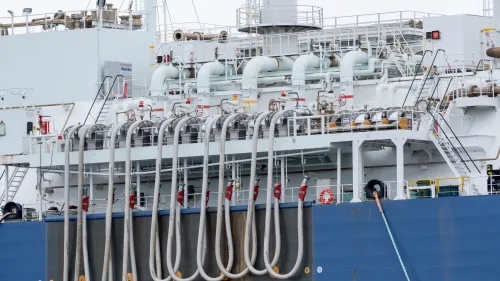
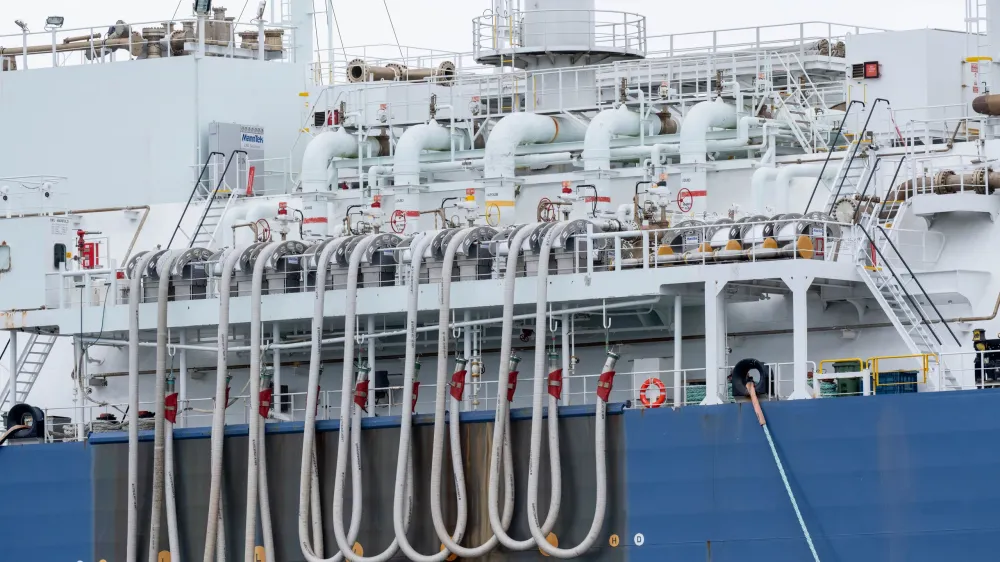
FSRUs receive liquefied natural gas delivered by tankers, turn it back into gas and supply it to the pipeline network. Deutsche Regas says its two vessels at Mukran will together have the theoretical capacity to deliver 13.5 billion cubic meters annually, equivalent to about 15 percent of Germany's total natural gas demand.
The additional ship is an existing vessel that must first undergo conversion. Work is due to start in the second quarter of 2027 and last about seven months. Wagner said the operating date remains uncertain, but the company wants the vessel available during winter 2027-28 and especially for storage replenishment the following spring.
According to Wagner, the conversion will leave the vessel technically almost new: its engines, regasification equipment and pumps will all be replaced. He said it would also meet the latest standards for energy efficiency and emissions. Deutsche Regas says the addition will strengthen supply security in Germany and Europe.
Mukran's permit and energy plans
The Mukran terminal already has permanent authorization for two FSRUs. In March 2026, the State Office for Agriculture and Environment of Western Pomerania (StALU) approved their operation using onboard gas generators, replacing a temporary permit arrangement, Offshore Energy reported.
For now, the terminal uses Neptune, a 2009-built FSRU with storage space for 145,000 cubic meters of LNG. According to LNG Prime, Deutsche Regas previously ended its charter agreement with the German government for Energos Power, which has 174,000 cubic meters of LNG storage capacity.
Deutsche Regas has also signed a memorandum of understanding with Finnish steel producer Outokumpu on supplying the terminal with industrial process heat and electricity from a planned biocarbon plant at Mukran port. LNG Prime reported that the companies intend to use those supplies to reduce the terminal's carbon emissions and improve its energy efficiency.
Low storage levels ahead of the coming winter
The planned Mukran addition is separate from Germany's preparations for winter 2026-27. Gas storage facilities were 61.1 percent full on October 21, 2026, compared with 75.4 percent a year earlier, according to data cited by Handelsblatt.
Germany has awarded contracts worth nearly 245 million euros to have extra gas available on standby for the coming winter, market operator Trading Hub Europe said on October 23. About 107 million euros covered special tenders to protect supplies in February and March 2027, while roughly 137 million euros covered regular tenders addressing grid bottlenecks.
Another LNG vessel is due to begin operating much sooner than the new Mukran ship. State-owned Deutsche Energy Terminal (DET) expects to start its fourth FSRU at Stade in early November. It already operates two in Wilhelmshaven and one in Brunsbüttel; Deutsche Regas operates the existing vessel at Mukran.
DET's chartered Energos Force reached the Stade-Bützfleth industrial port in mid-September 2026, Offshore Energy reported. The first fully loaded LNG tanker was expected in early November 2026. From 2027, DET expects the Stade terminal to supply up to 3.2 billion cubic meters of gas to the grid, enough for a year's heating for approximately 2.6 million four-person households.
Germany turned to floating import terminals after Russian pipeline gas deliveries ended in 2022. The governing coalition at the time moved quickly to establish LNG imports using FSRUs. Before that, Germany had no LNG import infrastructure of its own, unlike Spain, France, Belgium and the Netherlands.
Climate activists have criticized the expansion as oversized and as entrenching dependence on fossil fuels. Handelsblatt argued that the excess-capacity criticism had probably become less relevant for the coming winter: with storage levels low, existing FSRUs could help reduce the risk of a gas supply crisis.
Competition dispute with the state-owned operator
The expansion comes amid a long-running dispute between privately owned Deutsche Regas and DET, which is wholly owned by Germany's federal government. The European Commission authorized 4 billion euros in aid for DET, with an option to increase the amount to just under 5 billion euros.
Deutsche Regas alleges that DET offers regasification capacity at prices far below the charges set by the Federal Network Agency, creating what it considers an unlawful distortion of competition. DET denies the allegations. In early 2025, the agency said an expedited review had found no breach of the relevant rules.
Separately, Offshore Energy reported that Deutsche Regas had launched a legal challenge to the Commission's approval of a 4.96 billion euro subsidy scheme for German LNG terminals. The company argues that the scheme damages competition and weakens gas security.
Wagner said Deutsche Regas had cut its own prices partly in response to price competition with DET, which he described as ruinous. As a result, he said, the company earns less than it would under different conditions. It has recently added Engie, Equinor and BASF as customers, while Sefe, MET International and Total Energies also use its regasification capacity.