No agreement in third round
The third bargaining round began while the Ingolstadt demonstration was underway. According to Süddeutsche Zeitung and dpa, Bavarian employers rejected an IG Metall proposal first presented in Baden-Württemberg that would have permitted individual companies to depart from the collective agreement in exchange for binding commitments on investment and site security.
"We have not moved a single step forward," said Horst Ott, IG Metall's Bavarian district leader. "If that is the employers' answer, then we will step it up. We will expand the warning strikes." No date for a fourth round had been set as of November 9, 2026.
IG Metall is seeking a 5% pay increase and a one-year agreement. Employers across Germany's states and bargaining regions have made the same offer: a one-time payment equal to 1% of gross annual salary in summer 2027, followed by a 1.3% wage increase in summer 2028. Süddeutsche Zeitung and dpa reported that the offer falls below the inflation rate.
Employer representatives cited the industry's difficult conditions. The Bavarian employers' association vbm accused IG Metall of being unwilling to compromise and criticized the walkouts. It said Bavaria's metal and electrical industry had lost 11,000 jobs in 2026 as of November 9.
Rally draws workers from across the region
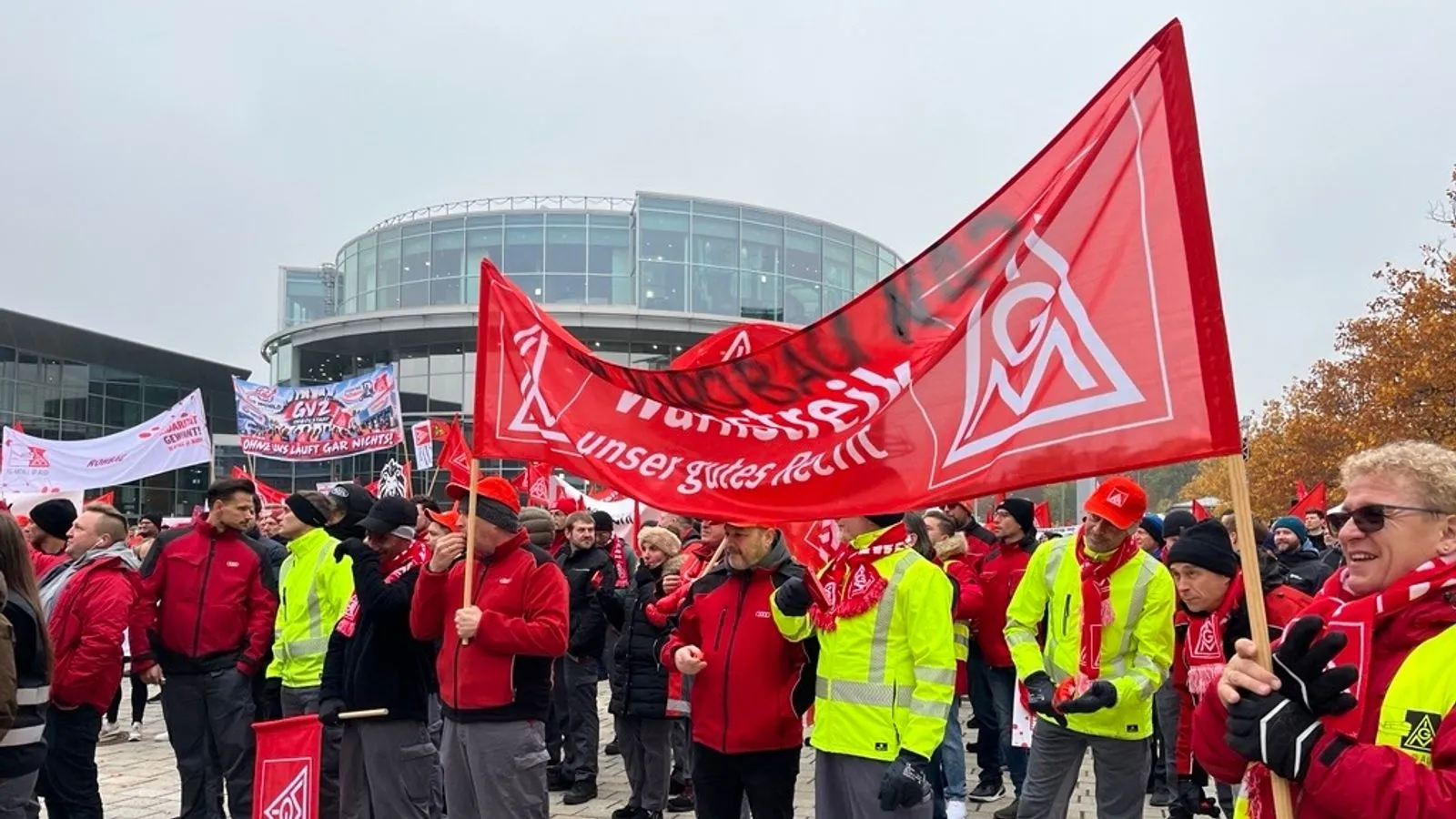
Police estimated that up to 8,000 people attended the Ingolstadt demonstration; IG Metall put attendance at 15,000. Workers came from Audi, Airbus, Wacker, GVZ, Schaeffler, Scherm and other employers.
The union-organized event opened to ABBA's "Mamma Mia! Here We Go Again" after repeated walkouts across Bavaria the previous week. Yellow high-visibility vests carried a message about working better together, while red IG Metall vests proclaimed that solidarity wins.
IG Metall reported 36,000 participants across Bavaria that day, with the largest rallies in Ingolstadt, Nuremberg and Augsburg. It was the biggest warning-strike day of the bargaining round so far. The union said 75,000 employees in Bavaria had joined warning strikes during the round's first week.
Pay demands and fears for jobs
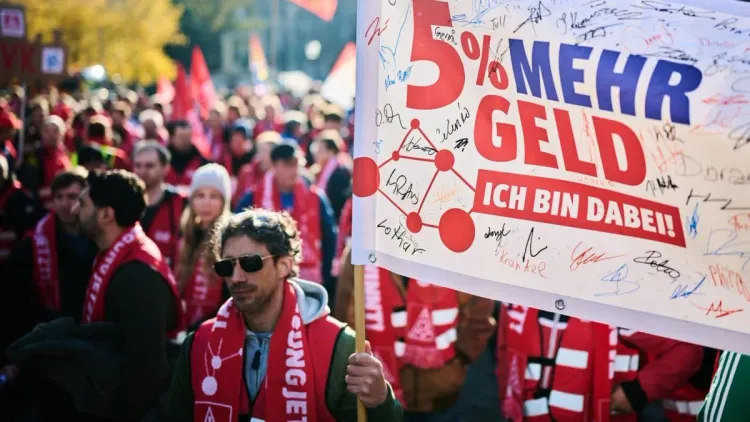
At the Audi rally, demands for higher wages appeared alongside calls to protect jobs. Some banners called for 5% more pay and secure employment; others contrasted executives' fight for bonuses with workers' fight to keep their jobs.
Audi works council member Andreas Straube dismissed the proposed 1.3% wage increase as effectively no increase at all. He has worked for the Audi Group for almost 30 years, starting on the assembly line before moving into logistics and becoming involved with IG Metall.
Younger demonstrators at the front of the rally sought an additional 110 euros in trainee pay. Among them was Rayan Abdelhafez, an 18-year-old trainee production mechanic whose work is mainly in the plant, including on the assembly line. He said he enjoyed working with cars and seeing how they were built, but felt the pay no longer justified the demands placed on him. Audi nevertheless remained an attractive employer to him.
Bernhard, a 47-year-old sales employee who joined Audi in 1997, described conditions as tense rather than catastrophic. He said he was increasingly unsettled by warning signs and by what he described as the employer's termination of the company's future agreement. Still proud to work for Audi, he wanted its employment protections preserved.
Manuel, an Audi painter for 10 years, objected to millions being paid to shareholders before reported results were revised downward. In his view, that reduced employees' profit-sharing payments and worsened their job prospects. He said workers were doing the work while others collected the rewards. He wanted security for his family and to remain at Audi for another 30 years.
Audi's employment agreement under pressure
The agreement at the center of workers' concerns, Audi's Zukunftsvereinbarung, was concluded in March 2025. According to BR24, it rules out compulsory layoffs through December 31, 2033, and protects monthly pay under the collective agreement as well as allowances. In return, it provides for up to 7,500 jobs to be eliminated through socially acceptable measures by 2029.
In October 2026, Audi CEO Gernot Döllner invoked the agreement's bad-weather clause to reopen negotiations. BR24 also reported that plant closures were under discussion within the VW group that month. Alongside three VW plants, Audi's Neckarsulm plant was repeatedly mentioned as a possible closure site.
US investment adds to workers' unease
Audi's announced US plant was another concern at the demonstration. On October 24, 2026, Döllner announced plans at a campaign event for US President Donald Trump to invest about $4 billion in a new plant in Georgia, creating around 4,500 jobs. A Bavarian state parliament motion says premium SUV models currently built in Bratislava are to be produced in Georgia starting in 2030.
Employee Moritz viewed the announcement as a troubling sign that investment was going abroad rather than into Germany. Christoph Vollnhals, who has spent 28 years at Audi, questioned the company's product strategy. In his view, Audi was building too many SUVs for the American market instead of the smaller, everyday cars bought by Europeans.
Vollnhals said some colleagues had been required to leave technical development for other assignments. He had never experienced anything similar during his 28 years with the company.