Company commitments would be required
IG Metall and the employers' association NiedersachsenMetall reported that the talks ended without a result. Despite warning strikes in recent days, the two sides had not narrowed their differences.
The union's proposal would create a separate, time-limited collective agreement for companies facing a structural and product crisis. It would aim to protect investment, value creation and jobs while allowing temporary, limited adjustments to contractual benefits at individual companies.
Any such adjustments would require documented, binding commitments from companies on investment, employment and keeping sites open. The bargaining parties would retain authority over the changes, with IG Metall members involved.
Thorsten Gröger, IG Metall's district leader in Lower Saxony, said the union had submitted its own plan because employers had yet to offer a concept for securing jobs and the industry's future. He described the proposal as relief for struggling companies in exchange for firm commitments to local investment and employment.
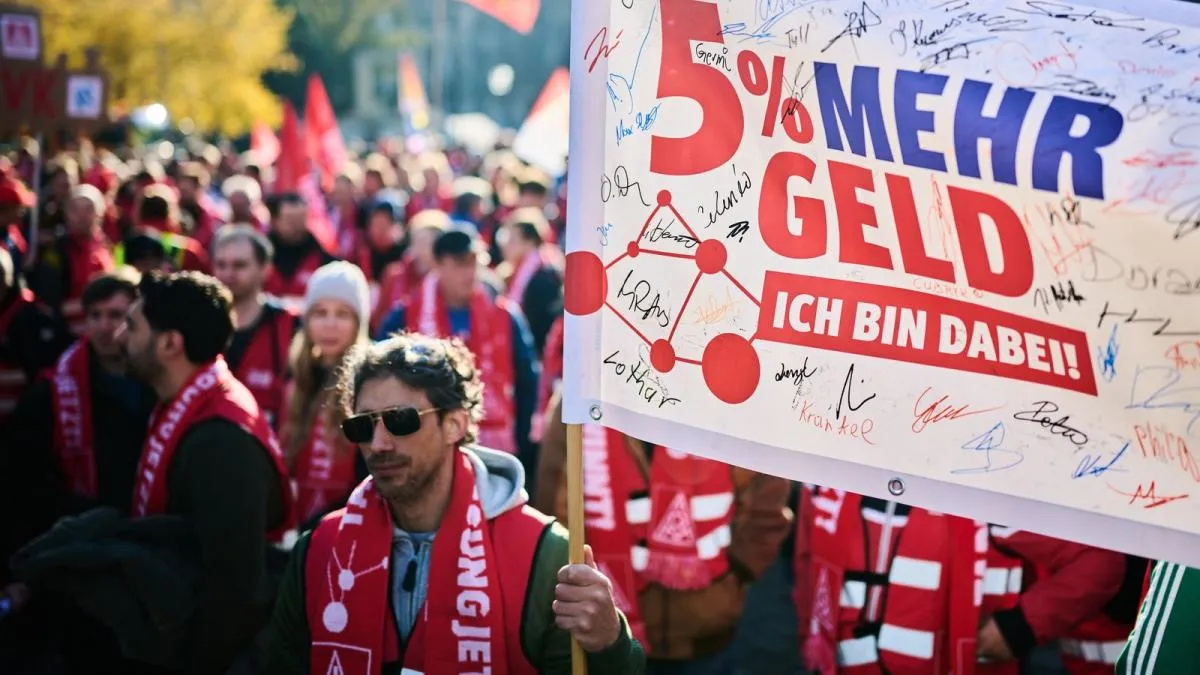
Alongside its 5 percent pay demand, IG Metall's package calls for contractual profit sharing at well-performing companies and a social component for low-income workers and apprentices, according to the union.
Pay remains a dividing point
The employers' response to the new union proposal was not immediately clear. Their chief negotiator, Mladen Petkovic, gave a positive assessment of the talks but said the sides remained apart on pay. NiedersachsenMetall wants IG Metall to shift its position, even as both parties discuss how more flexible collective agreements could help secure the industry's future in Lower Saxony.
The employers' offer would raise pay scales by 1.3 percent in July 2028 and run through December 31, 2028. It also proposes a one-time payment in July 2027 worth 1 percent of average annual contractual gross pay. According to IG Metall, employers estimate that payment at about 660 euros before tax; the union says the amount varies by bargaining area, from 555 to around 800 euros.
Under the offer, companies earning little money could suspend the one-time payment. Handelsblatt reports that an existing rule known as automatic differentiation allows certain payments to be suspended when the net return on sales falls below 2.3 percent. Employers want to expand that differentiation and make it permanent.
IG Metall calculates that the proposed 1.3 percent increase, spread over the offer's 26-month term, represents only about 0.6 percent a year, compared with inflation of up to 3 percent.
According to the employers' umbrella association Gesamtmetall, this was the first time in the industry's bargaining history that employers presented a coordinated offer simultaneously in five bargaining areas. Agreed nationwide, it was delivered at the start of the second round in Baden-Württemberg, Bavaria, North Rhine-Westphalia, Lower Saxony and the North.
Warning strikes across the industry
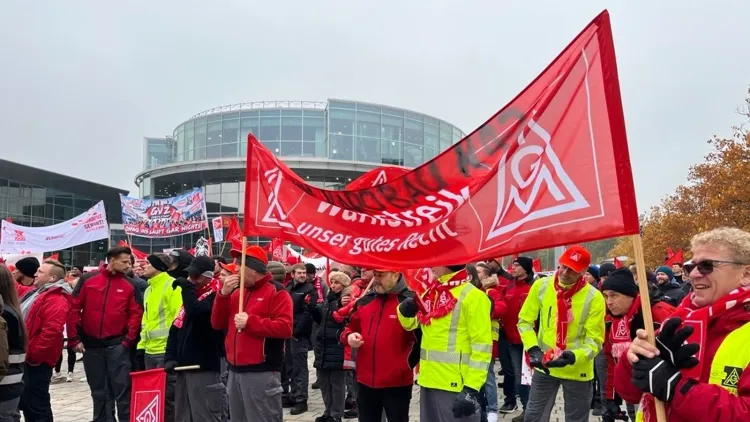
Workers began warning strikes after the obligation to refrain from industrial action expired at midnight on November 1. By November 5, 2026, 280,000 employees at 2,000 companies nationwide had participated, according to IG Metall. The union also reported that more than 16,500 workers in Lower Saxony and Saxony-Anhalt had joined warning strikes since November 1.
The 2026 bargaining round covers about 3.7 million employees in Germany's largest industrial sector, IG Metall says. Its districts negotiate separately with regional employers' associations across 15 bargaining areas. The agreements govern pay and working conditions in industries including mechanical engineering, metalworking and electrical engineering.
Separate agreements and regional talks
IG Metall's Hanover district oversees two bargaining areas with about 120,000 employees: Lower Saxony and Osnabrück-Emsland-Grafschaft Bentheim. Each has separate negotiations. Northwestern Lower Saxony belongs instead to the Küste district, which negotiates with Nordmetall for around 130,000 workers across that area, Bremen, Hamburg, Mecklenburg-Vorpommern and Schleswig-Holstein.
Volkswagen AG employees also negotiate separately under a company-specific collective agreement that expires at the end of the year.
IG Metall's third-round schedule lists November 6, 2026, for Lower Saxony, Berlin-Brandenburg, Küste and the Mitte group, which comprises Hesse, Rhineland-Palatinate and Saarland. Talks in Saxony, Osnabrück-Emsland-Grafschaft Bentheim, Saxony-Anhalt and North Rhine-Westphalia are scheduled for November 9.