A narrower agreement for Montreal
EU member states approved the revised declaration through a written procedure on Wednesday evening, according to WELT. It is scheduled for publication Friday at the close of the October 29-30 summit in Montreal. Canadian Prime Minister Mark Carney is hosting the 21st Canada-EU summit together with European Commission President von der Leyen and European Council President António Costa.
The earlier draft would have given Canada a role as an associate member in discussions and consultations on major policy and regulatory initiatives, with the scope of that status to be settled by the 2027 summit. Both references to associate membership and the associate member designation have been removed.
The revisions also narrow the economic commitments. A proposed pledge to give each other preferential treatment in economic security measures has become an undertaking to try to minimize adverse effects on one another. An explicit commitment to greater financial market integration was deleted.
Carney downplayed the dispute over terminology, saying that the test would be the difference the agreement made to Canadians' lives, rather than the label attached to it.
Two different ideas of associate membership
EU diplomats attributed the resistance to uncertainty about what the proposed status would mean and inadequate consultation between the Commission and the Council representing member states. Diplomats said France and Italy were among the countries that raised concerns alongside Germany.
CBC News reported that Germany regarded the designation as a red line. An official who attended the meeting told The Globe and Mail that seven of the EU's 27 members opposed including it in the communiqué. The objections came from large member states and concerned the undefined status, rather than the underlying idea of closer ties.
The wording also overlapped with a different proposal for Ukraine. In June, Merz suggested associate membership as a step toward full EU accession, allowing Ukraine to attend summits and meetings of ministers regularly before joining.
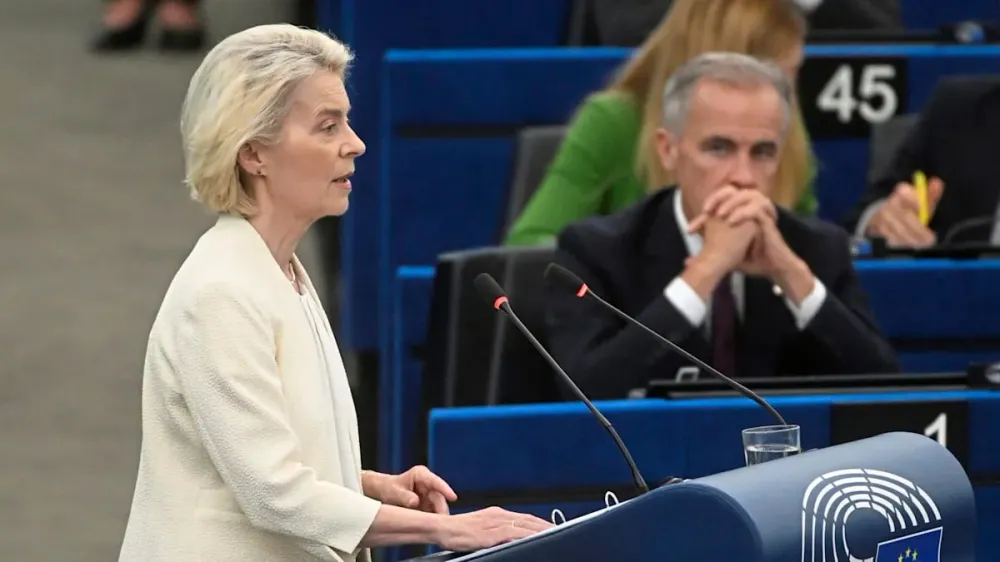
Von der Leyen's proposal for Canada served a different purpose: the closest possible relationship with a country that has no legal route to EU membership. She introduced it apparently without coordinating with Merz. According to The Globe and Mail, she first floated the idea at her September 16, 2026, State of the Union address to the European Parliament in Strasbourg. Carney was present, becoming the first foreign head of government to attend the annual address, Al Jazeera reported.
Even after the wording was removed from the draft, von der Leyen continued to use it publicly. CBC News reported that, on arriving in Montreal on Wednesday, she wrote on social media that the EU wanted to bring Canada "closer to us than ever before, as associate member of the EU."
Cooperation beyond the disputed label
The revised declaration centers on an alliance for the future, a description previously used mainly by Carney. Its aims include lowering trade barriers, facilitating investment and keeping essential raw materials, medicines and technologies available during crises. A proposed business council would connect companies on both sides, while a study would examine the feasibility of additional Canadian liquefied natural gas exports to Europe.
The broader plans call for closer coordination on energy, climate protection, technology and security, along with greater Canadian participation in EU research, education and defense programs. The stated goals are to advance shared interests more effectively and reduce dependence on other countries.
Those plans build on existing agreements. The Comprehensive Economic and Trade Agreement, or CETA, entered into force in 2017 and removes duties on up to 99 percent of goods traded between Canada and the EU, according to the European Council, as cited by Al Jazeera.
At their previous summit, held in Brussels on June 23, 2025, the two sides launched the New EU-Canada Strategic Partnership of the Future and signed a Security and Defence Partnership. Canada then became the first non-European country to join the EU's Security Action for Europe initiative in February 2026. Known as SAFE, the 150-billion-euro defense procurement loan program gives Canadian companies preferential access to contracts it finances.
The Montreal draft also proposes new subsea cable infrastructure linking Europe, Canada and Asia, Reuters and The Globe and Mail reported. The two sides would assess possible cable routes and interconnection points as part of an effort to improve secure international connectivity.
Relations with Washington and support for Ukraine
The effort to deepen EU-Canada ties comes amid diminished trust in the United States under President Donald Trump. His tariff disputes and territorial claims have increased doubts on both sides of the Atlantic about Washington's reliability as a partner.
Trump initially dismissed the associate membership proposal as ridiculous. He warned that, if it harmed US interests in what he considered a hostile act, he could impose high tariffs or stop trade with Europe across many sectors.
The draft declaration also addresses other foreign policy issues. According to Reuters and The Globe and Mail, Canada and the EU pledge continued comprehensive support for Ukraine across political, financial, economic, energy, humanitarian, military and diplomatic matters. The text says they "deeply regret" US sanctions against the Netherlands-based International Criminal Court.