A new flagship with two names
BYD's top-tier brand positions the Altior above its U7 electric sedan, with the Rolls-Royce Ghost, Mercedes-Maybach S-Class and Maextro S800 as intended rivals. Yangwang calls it its first "ultra-luxury executive flagship sedan"; the broader lineup also includes the U8 and U8L SUVs and U9 electric supercar.
The Abu Dhabi debut follows Yangwang's showcase of performance above 500 km/h. The brand delivered 3,251 vehicles in China from January through September 2026, a 38.9% increase from a year earlier, according to China EV DataTracker.
The international Altior badge replaces the letter-and-number naming pattern used for the U7, U8 and U9. In China, the car is sold as Dingyao. Yangwang sales division general manager Hu Xiaoqing said the Latin name Altior means "higher," echoing Yangwang's meaning of "to look up." In the Chinese name, Ding signifies stability and load-bearing capacity, while Yao means brilliance.
Hu said development took three years, with more than 100 proposals considered for the front-end design.
An upright nose and coach doors
At 5.6 meters long, 2.03 meters wide and 1.6 meters tall, the Altior has a 3,500 mm wheelbase. Its short front overhang and nearly vertical nose establish its proportions, while two lines extend 4.8 meters along the sides. Two-tone paint and an elongated C-pillar are other exterior features.
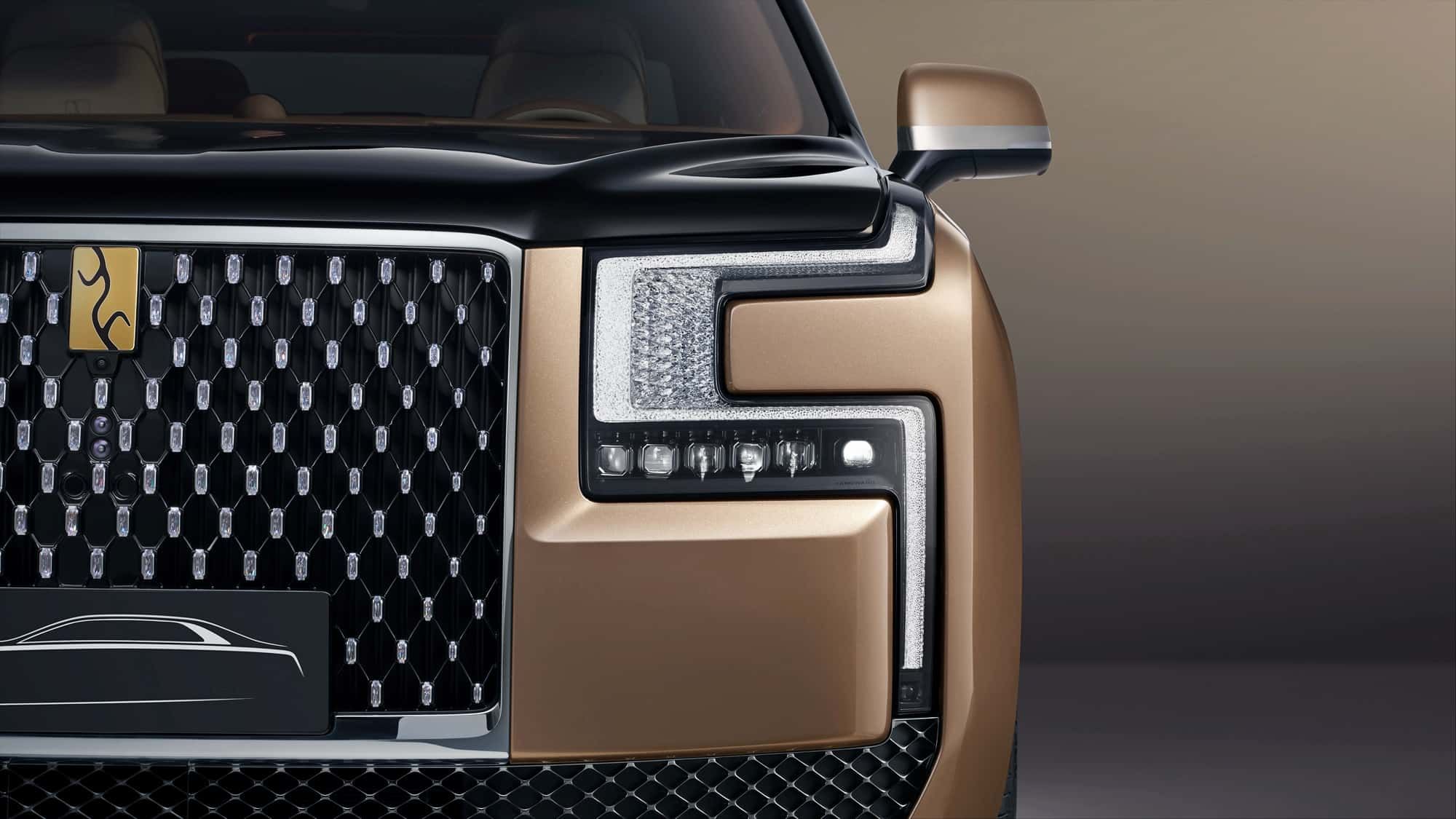
The grille incorporates 137 gemstone-cut elements. Lighting inspired by the traditional Chinese Ding ritual bronze vessel also provides an arrival sequence: when a keyholder approaches, 12 rotating elements light up in succession from the outside toward the center.
Buyers can choose among three 21-inch wheel treatments: multi-spoke wheels, polished monoblock disc wheels or fully closed covers. Each is paired with noise-reducing tires sized 275/45 21.
The front and rear doors open in opposite directions, with opening angles of up to 80 degrees at the front and 90 degrees at the rear. Custom-made umbrellas are housed inside the doors.
Four seats, rear-seat controls and Chinese craftsmanship
A symmetrical four-seat arrangement gives rear passengers individual seats separated by a substantial center console. The features shown include reclining backrests, leg rests, powered privacy shades and a motorized compartment holding champagne flutes.
Rear accommodation includes 354 mm of knee room and 1,209 mm of legroom. The two rear seats use an aviation-inspired zero-gravity design, with four spherical massage heads in each seat. A single-button relaxation setting coordinates the seats, lighting, audio and fragrance. It reclines the seats, extends the leg rests, closes the shades, dims the ambient lighting and starts the massage functions.
Traditional Chinese materials and craft techniques feature throughout the cabin. Hand-polished yellow Hetian jade forms softly rounded details in the air vents, while the upholstery combines Suzhou embroidery with perforations. Full-grain semi-aniline leather, pure wool floor mats and selected natural woods round out the material selection.
Jewelry-making influenced the controls, which incorporate 48 decorative elements across 11 locations. The metal switches are intended to provide a weighty feel and precise tactile feedback. During development, the team gently struck metal components with small hammers to compare their sound and feel.
The 39-speaker Dynaudio audio system adds its own startup sequence, with tweeters that rotate and rise. An electrically operated 21.4-inch ceiling screen supports entertainment and screen sharing for video conferences.
Refrigerators serve both the front and rear seats. The rear unit holds 5.5 liters and has independent temperature control for cooling or warming. It sits ahead of a 532-liter luggage compartment.
Independent wheel control and active suspension
The e4 platform gives each wheel its own independently controlled electric motor. It adjusts the direction and magnitude of wheel torque more than 100 times a second to manage power delivery as conditions change. Yangwang says the system can also cope with a tire failure at high speed.
A tank-turn function allows the sedan to rotate almost on the spot. An emergency swimming function is intended to provide support if the vehicle accidentally enters water.
Next-generation DiSus suspension control actively manages body movement in six degrees of freedom. The system reads the road ahead and adjusts the suspension in real time, with the aim of absorbing bumps and reducing lateral movement for occupants.
BYD's God's Eye A driver-assistance system provides navigation-based assistance from a parking area to the destination, as well as highway, expressway and parking assistance. It runs on BYD's own algorithms.
Chinese media reports identify BYD's Xuanji A3 4nm driving chip as planned hardware for the Altior, but the company has not specified the sedan's computing setup. BYD's separate announcement of a three-chip configuration delivering more than 2,100 TOPS does not confirm that configuration for this car.
Battery claims, editions and pricing
Yangwang specifies a second-generation Blade battery and an all-electric range exceeding 1,000 kilometers on China's combined CLTC test cycle. Flash charging is also part of the announced package, though technical details remain undisclosed.
Earlier reports associated the Altior with solid-state batteries, but BYD has not confirmed their use in this model. The company's broader solid-state battery plans call for vehicle demonstrations around 2027 and mass production around 2030.
The sedan will be offered in Executive and Bespoke versions. The first Bespoke edition, Shanhe Dingyun, draws on Chinese mountain-and-river imagery, combining brown and gold exterior paint with jade-inspired cabin details. It is a limited edition aimed at collectors.
Pricing remained unannounced at the November 2026 debut. Earlier reports suggested roughly 2 million yuan, or approximately $280,000, but that is an estimate rather than a confirmed starting price. BYD has also withheld power output and other performance figures.