Party branding on a religious figure
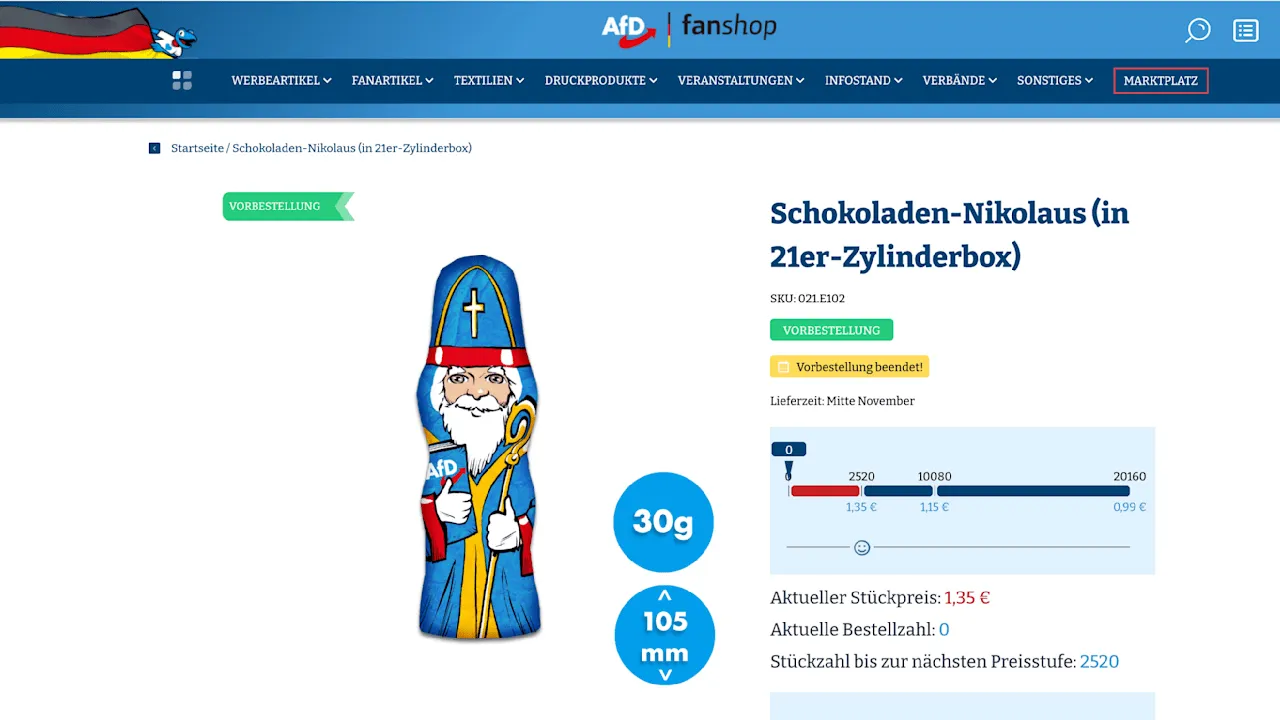
The chocolate figure wears blue robes and a bishop's miter, carries a crosier in its left hand and holds a book with the AfD logo in its right, Bild reported. It depicts Saint Nicholas of Myra, a fourth-century Christian bishop from what is now Turkey.
According to t-online, the figure initially cost 99 cents on preorder before its price rose to €1.35 each.
Franz-Josef Overbeck, the Catholic bishop of the Ruhr region and Germany's Catholic military bishop, told Bild that putting the party's branding on a depiction of Saint Nicholas crossed a boundary. He accused the AfD of appropriating Christian symbols for political advertising and called for agreement that such symbols should never serve partisan purposes.
Overbeck distinguished the product from chocolate figures sold by soccer clubs in their team colors, saying those generally omit Christian symbols. Bild also reported that other political parties sometimes distribute chocolate Saint Nicholas figures during election campaigns, but without party logos or colors.
AfD defends the product as orders rise
A spokesperson for the AfD's federal executive told Bild that the party was liberal-conservative and committed to Christian values, making the traditional Saint Nicholas figure particularly appropriate for it. The spokesperson suggested that churches should regard the product as a reminder of a saint who embodied those values.
The fan shop subsequently advertised a second order round, citing high demand. According to swp.de, its order overview showed 22,995 figures ordered as of November 18, 2026.
The shop operator told Bayerischer Rundfunk that the figure had also been sold the previous year. The operator attributed a significant increase in demand this year to the public debate and said most orders came from private individuals rather than party officials.
Christianity beyond party politics
Johann Hinrich Claussen, cultural representative of the Evangelical Church in Germany (EKD), also objected. He called the product "embarrassing and revealing" and said it demonstrated the AfD's lack of understanding of Christian traditions and respect for Christianity. As Deutsche Welle reported, he described Christianity as "supra-partisan."
Claussen pointed to Nicholas's association with Myra, in present-day Demre, Turkey, saying the bishop "stood clearly for uniting the occident and the orient." He also noted that Nicholas is the patron saint of rescues at sea, arguing that the AfD knew little about what Christians hold sacred.
For Georg Austen, general secretary of the Catholic aid organization Bonifatiuswerk, the issue was also whether those using Nicholas's image lived up to his example. Austen said the saint represented Christian charity, solidarity and service to people in need, and that anyone invoking or selling his image should be judged against those values in words and deeds. He particularly questioned replacing the Bible normally carried by the figure with the AfD party program.
Bonifatiuswerk sells its own chocolate Saint Nicholas figures, using some of the proceeds for children's hospice services and social projects, DOMRADIO.DE reported. Its annual nationwide campaign, "Tat.Ort.Nikolaus," encourages good deeds for people in need.
That charitable tradition underlies Saint Nicholas Day on December 6. According to tradition, Nicholas helped poor and needy people and gave away part of his wealth, inspiring the custom of giving children sweets on his feast day.
The dispute follows an earlier rejection of the AfD by the German Bishops' Conference. In February 2024, the bishops issued a declaration titled "Völkischer Nationalismus und Christentum sind unvereinbar," meaning ethnic nationalism and Christianity are incompatible. They said Christians could not vote for right-wing extremist or right-wing populist parties that agitate against migrants, Muslims or Jews.
Lawyer raises possible legal challenges
Berlin trademark lawyer Jan Froehlich told Bild that the use of Saint Nicholas and the Bible could be challenged legally. In his assessment, it violated public morality under trademark law and was therefore impermissible.
Froehlich argued that linking a figure venerated as a saint by the Catholic and Eastern churches with messages that could be viewed as politically extremist could support that assessment. He also pointed to the substitution of the AfD party program for the Bible in the figure's hand.
According to t-online, Froehlich also raised the possibility of criminal liability. He cited a Federal Court of Justice ruling under which certain organizations' visible use of religious symbols can be punishable if churches reject those organizations' activities.