Remembrance at the synagogue site
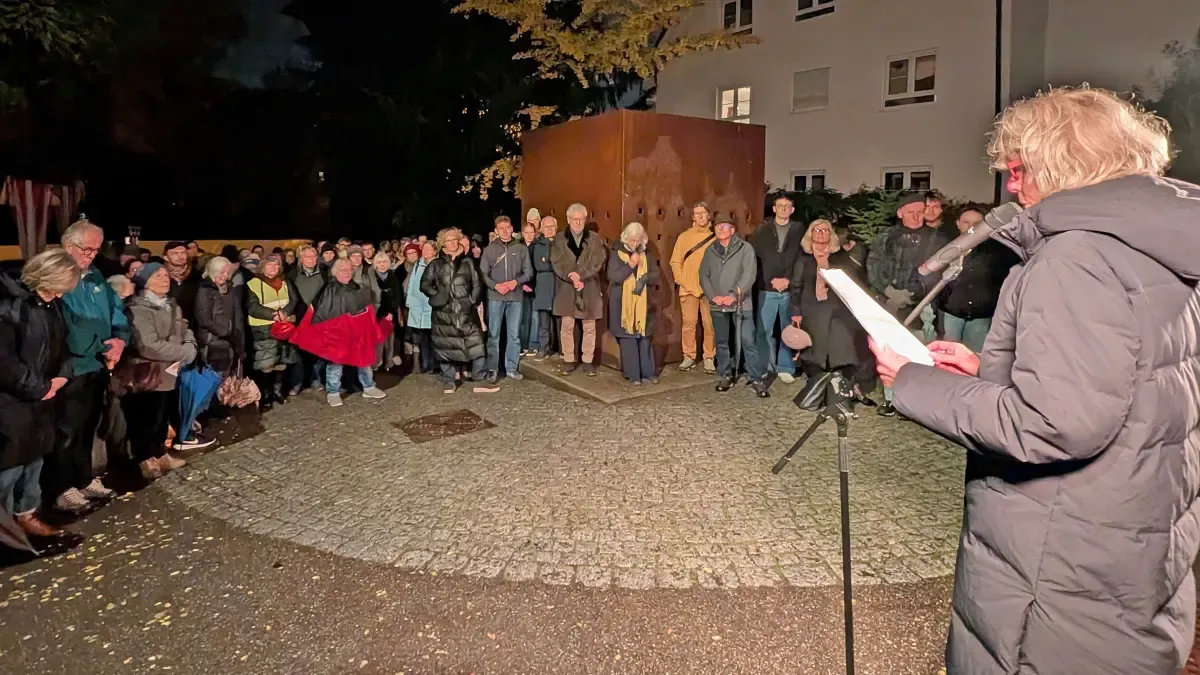
The central ceremony began at 6 p.m. on Monday at Synagogenplatz on Gartenstraße, marking 88 years since the Reichspogromnacht. Tübingen's arts and culture department organized it with the Geschichtswerkstatt Tübingen and other partners. City Councilor Annette Schmidt spoke on behalf of the council.
In its October 29 announcement, the city listed Dr. Martin Ulmer of the Geschichtswerkstatt Tübingen, Schmidt of the AL/Grüne council faction and youth council representatives as speakers. Mayor Boris Palmer and Dr. Gundula Schäfer-Vogel, the deputy mayor responsible for culture, were also expected to attend.
The memorial at the site dates to 2000 and was designed by the architectural group Werkgemeinschaft Nürtingen and sculptor Gert Riel. Its steel cube surrounds a fountain and represents the destroyed synagogue. The cube's 101 square openings commemorate Tübingen's expelled and murdered Jews, whose names appear on three panels beside the water channel, according to the Geschichtswerkstatt.
The attack and its aftermath
Built in 1882, the synagogue on Gartenstraße served as a place of Jewish prayer and study. During the night of November 9–10, 1938, SA and SS men ransacked and looted it as part of the pogrom ordered across the Reich, according to the city. In the early morning, three subordinate Nazi Party officials set fire to the interior on the district party leader's orders. Only the building's foundations remained.
The Geschichtswerkstatt Tübingen identifies the official who ordered the burning as Nazi Party district leader Hans Rauschnabel. After the attack, five Tübingen Jews were arrested and deported to Dachau for several weeks. One of them, Albert Schäfer, died from the mistreatment he suffered, the organization says.
Emigration had already sharply reduced the Jewish community. It was forced to pay for the complete demolition of the ruined synagogue before dissolving in March 1939. In 1940, it was also forced to sell the land to the city for far less than its value, according to the Geschichtswerkstatt.
The organization reports that 80 of the community's roughly 100 members escaped in time to the British Mandate of Palestine, the United States and other countries. It records 23 people deported to Riga, Theresienstadt and Auschwitz and murdered there, and says only two survived the Holocaust.
Students lead a second commemoration
A second ceremony took place at 7 p.m. that day at Tübingen's Stiftskirche, organized by the Arbeitsgemeinschaft Christlicher Kirchen (ACK) Tübingen, an association of Christian churches.
According to the city's 2026 program, Anke Lohrberg and Jonathan Lacher of the Karl-von-Frisch-Gymnasium led the service with their upper-secondary students and the students' Israeli exchange partners. The school's big band performed.