Evonik leaves the door open to talks, not negotiations
BASF's latest offer of 24 euros per share values Evonik at about 11 billion euros. Süddeutsche Zeitung reported that the price represents a premium of roughly 39 percent over Evonik's unaffected closing share price. The proposal follows an initial offer of 22.15 euros per share that Evonik declined to engage on, according to WirtschaftsWoche.
In its Friday morning announcement, Evonik said its board remained focused on developing the company independently. It agreed only to an informational, confidential exchange. BASF responded that it could not understand the refusal to negotiate, citing its offer and extensive commitments to employees and sites, but acknowledged Evonik's willingness to talk.
At BASF's quarterly results presentation on Wednesday, CEO Markus Kamieth argued that the companies' complementary portfolios and strengths made a takeover a logical, timely step that could create a more competitive and resilient global chemicals group.
RAG-Stiftung has particular influence over the outcome. According to Handelsblatt, the foundation held about 43 percent of Evonik's shares when the takeover approach was disclosed at the end of September 2026, making it the company's largest shareholder.
Evonik is also considering an acquisition of its own. WirtschaftsWoche reported on October 23, 2026, that the company was examining a purchase of US specialty chemicals producer Ashland, valued at around $3.3 billion, as part of its consolidation strategy. The report said a deal could complicate BASF's takeover plans by changing Evonik's structure and balance sheet.
A cluster model for German operations
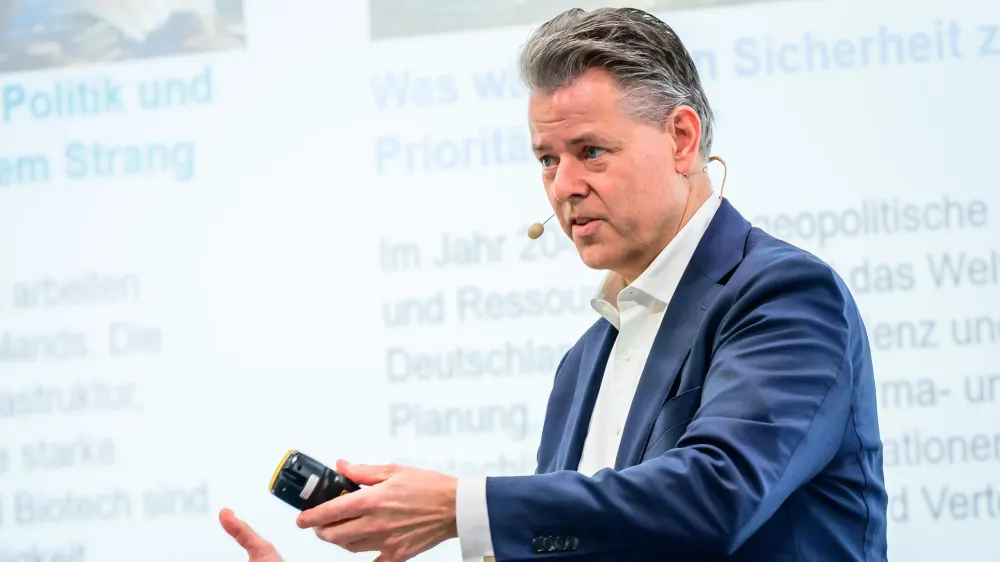
A day before Evonik rejected the bid, site-transformation executive Ralph Marquardt outlined the company's plans at the WirtschaftsWoche Innovation Day in Erlangen. He said Germany's chemical sites needed to evolve beyond production into research and development hubs linking universities, startups and large companies.
His model is the life-science cluster in Boston and Cambridge, where chemical specialists operate near customers, suppliers, researchers and users of their products. Marquardt said Germany lacked comparable clusters. He described a persistent reluctance to adopt ideas developed elsewhere, with companies relying heavily on their own research facilities and findings. That approach had worked for years but was no longer sufficient, he said. Long development cycles also made it difficult for chemical startups to attract venture capital.
Evonik is defining distinct roles for its six major German production sites, concentrating each on particular products and activities. It also intends to manage business units according to whether their role is to generate growth or cash.
What would change at the six core sites
Essen's planned focus is digital formulation development, replacing painstaking manual work used to develop additives for products such as paints and mattress foams. Evonik intends to expand research in a new cluster with Ruhr University Bochum into a transfer center.
At Marl, the company wants to turn its integrated base-chemicals site into a demonstration hub for green industry. The plan envisions green hydrogen moving through existing large pipelines and attracting new producers, including direct air capture specialists.
Rheinfelden would expand beyond its initial production of metal oxides to become a silicon center. Cooperation with partners such as solar-panel recycler Rosi could allow silicon from old photovoltaic modules to be recovered and reused.
Hanau is intended to become an electrochemistry hub that attracts startups. Darmstadt and Wesseling would specialize as innovation centers for specialty chemicals.
The timetable will vary by site. Marquardt identified 2045 as the target year, also the reference year for an industry-wide VCI study examining possible paths for Germany's chemical industry amid geopolitical and economic crises. He said Evonik's measures addressed needs common to the different scenarios and the requirements for renewed success.
Marquardt wants university centers and startups to establish operations at the sites. Ideally, employees would move between companies, research organizations and users of their products, then return with different experience—a pattern he said was rare today. He argued that preserving a competitive lead through such exchanges could help preserve employment.
Job reductions, closures and sales
The site plans accompany a restructuring program announced in June that aims to eliminate about 10 percent of Evonik's workforce by 2029. Germany, where the company has many employees, accounts for 2,150 planned reductions in administration and production.
An earlier restructuring, begun in October 2023, flattened administrative hierarchies and removed management positions. About 2,000 administrative jobs and another 800 production jobs were eliminated. The first phase is intended to reduce costs by roughly 400 million euros by the end of 2026. Together, the ongoing program and the measures announced in June are expected to eliminate about 6,000 jobs by the end of 2029.
WirtschaftsWoche reported that Evonik has contractually ruled out compulsory redundancies in Germany until 2032. The reductions are therefore to rely on voluntary measures, including severance agreements, early retirement and placement in other jobs inside or outside the company.
The company also plans to leave its global polyester business, which generates about 150 million euros in annual revenue, according to WirtschaftsWoche. Its Witten site, employing 266 people, is scheduled to close in 2027, with another 45 positions to be cut in Marl and 35 in Shanghai.
Two smaller German sites are also due to close as their businesses are concentrated at larger locations. According to Evonik and WirtschaftsWoche, Hamburg, with about 50 employees working in cosmetics and personal care, is to close by mid-2027. Bitterfeld, where about 40 employees produce chlorosilanes, is scheduled to close at the end of April 2027.
Evonik has already placed its chemical-park operations in a new company, Syneqt, affecting about 3,500 employees. A sale process is due to start in 2027. Negotiations are also underway to sell the remaining base-chemicals business, Oxeno, WirtschaftsWoche reported.
The workforce reductions are part of a broader retrenchment in Germany's chemical industry. WirtschaftsWoche reported that Wacker plans to eliminate more than 1,500 jobs by the end of 2027, mostly in Germany. Lanxess plans a further 550 cuts, about two-thirds of them in Germany.
Growth businesses and markets outside Europe
Evonik intends to exit businesses worldwide that no longer offer sufficient prospects. In a September press release, interim CEO Claus Rettig said the company needed leading positions in its chosen activities to remain at the forefront of the industry. Rettig, who normally runs Evonik's Asian business from Singapore, is filling in for CEO Christian Kullmann while he recovers from an illness.
Among the new initiatives is a business line called "Designed Polymer Solutions." According to WirtschaftsWoche, it will bring together growth activities serving aerospace, automotive and gas-separation markets, including biogas and hydrogen applications.
Evonik sees its main growth opportunities outside Europe, even as it restructures its German operations. Europe currently accounts for 48 percent of revenue. The company wants to reduce that dependence and eventually draw one-third of sales each from Europe, Asia and the Americas.